The reliable place to see Zanzibar red colobus monkeys is Jozani Chwaka Bay National Park in the southeast of the island, where habituated troops feed within a few metres of the main trail. The park opens daily from 7.30am to 5pm and the entry fee includes a ranger guide. Smaller populations survive on Uzi and Vundwe islands. The species is endemic to Unguja and lives nowhere else on earth.
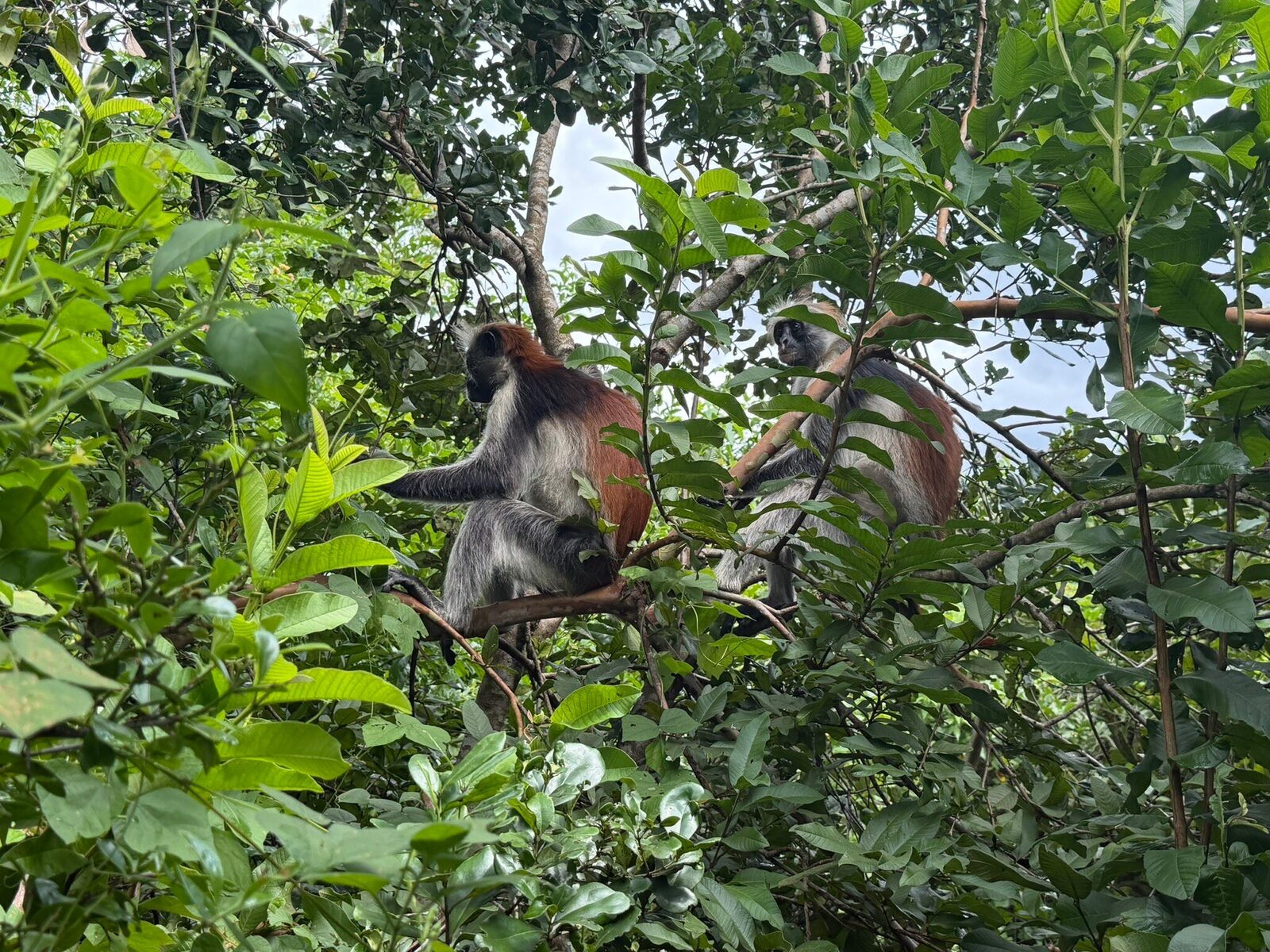
Early morning is the whole game here. Arrive at half past eight and the monkeys are feeding in low branches; arrive at eleven and they are asleep in the canopy.
Jozani Chwaka Bay National Park Red Colobus Tracking
Jozani is Zanzibar’s only national park and holds the most accessible population of the species. A red colobus tracking tour here bears little resemblance to primate trekking on the mainland: there is no hiking, no permit lottery and no hours of searching.
The troops living around the main trail are habituated to people and routinely feed in branches within a few metres of the path. You walk a flat, marked route through groundwater forest with a ranger, and the monkeys are usually simply there, working through leaves and unripe fruit at head height.
Park rules ask visitors to stay a few metres back and never to touch or feed them, which protects the animals from disease transmission and protects you from a wild primate with strong teeth. Sightings are common rather than guaranteed.
The whole visit takes an hour for the forest trail, or around two hours including the mangrove boardwalk a short drive from the main gate.
Be at the gate between eight and half past. The troops feed at low level in the early morning, move high into the canopy by around eleven, and that is exactly when the tour coaches arrive.
What the Zanzibar Red Colobus Looks Like
Distinctive enough that you will not confuse it with anything else on the island.
Adults carry a russet red back and shoulders, a pale cream underside, and a dark face ringed with white fur that gives them a permanently startled expression. They have no thumbs, which is normal for colobus monkeys, and long limbs built for moving through branches rather than on the ground.
They live in troops of a dozen or more, are noisy with each other, and feed almost entirely on leaves and unripe fruit. Ripe fruit ferments in their specialised stomachs, which is why they avoid it, and it is also why the species struggles when its forest is fragmented into farmland.
You will also meet Sykes monkeys, sometimes called blue monkeys, along the same trail. They are grey brown rather than red, considerably bolder, and entirely willing to take unattended food from a car park.
Uzi and Vundwe Islands: The Other Red Colobus Populations
Jozani is not the only place the species survives, though it is the only place set up for visitors.
Populations live on Uzi Island in the south, connected to the main island by a causeway through mangrove, and on neighbouring Vundwe. Both are undeveloped and largely used for fishing rather than tourism, and the colobus there have been the subject of conservation research into habitat loss and their status outside the park.
Scattered groups also survive in forest fragments elsewhere on Unguja, in coral rag thicket and on the edges of farmland, but these are not habituated and are hard to find without local knowledge.
For a visitor with a day rather than a research project, Jozani is the answer. The island populations matter because they show how thin the species’ hold on Unguja actually is.
Why the Species Is Endangered and What Protects It
The Zanzibar red colobus is classified as endangered and lives on one island of roughly 1,666 square kilometres shared with close to a million people.
The pressures are straightforward. Forest has been cleared over generations for farmland, building material and fuel on an island with thin coral rag soils and limited land. The monkeys were historically hunted, and were treated as an agricultural pest where they raided crops. What remains of their habitat is fragmented, which isolates troops from one another.
Jozani was set aside as a forest reserve in 1960, given protected status in 1984 and later became Zanzibar’s only national park, covering the forest, the surrounding coral rag and the mangrove systems around Chwaka Bay.
Entrance fees fund ranger staff and maintenance, and surrounding villages receive a share of park revenue, which gives the communities living beside the forest a direct stake in it remaining. That is worth knowing when you pay at the gate.
A primate that exists on one island and nowhere else, sitting in a tree three metres from a public footpath. Nothing else in East Africa offers that.
What Else Lives in Jozani Forest
Sykes monkeys. Common along the trail and around the car park, bolder than the colobus and unbothered by people. Keep food out of sight.
Aders’ duiker and blue duiker. Small, shy forest antelope living in the coral rag thicket. Sightings are uncommon rather than routine, so treat one as a bonus.
Bushbabies. Present but nocturnal, so a daytime tour will not find them. Guides can usually point out where they sleep.
Mangrove wildlife. On the boardwalk near Chwaka Bay, fiddler crabs, mudskippers, juvenile fish among the prop roots and kingfishers hunting from the branches.
Photographing Red Colobus Monkeys on a Forest Tour
Conditions are trickier than the proximity suggests, because you are shooting upward into a bright canopy from a dark forest floor.
Early morning helps twice over: the animals are low and the light coming through the trees is softer. A zoom in the range of seventy to two hundred millimetres covers most situations without needing to crowd the animals, though there will be moments when a wider lens is more useful because a monkey is closer than you expected.
Expect to push the sensitivity up. Flash is not permitted and would be pointless anyway. Patience beats chasing: pick a feeding troop, stand still and let them come through the branches above you rather than following them along the trail.
Combining Red Colobus Tracking With Other Zanzibar Tours
Jozani sits on the road between Stone Town and the east coast, which makes it one of the easiest things on the island to attach to another day.
The standard combination is a morning at the forest followed by an afternoon on the east coast at Paje or Jambiani. Full day tours from Stone Town frequently pair Jozani with a spice farm tour, and longer versions add Kuza Cave or The Rock restaurant at Michamvi.
A dawn dolphin trip at Kizimkazi followed by Jozani on the drive back is also common, though it makes for a very long day with a five in the morning start.
Whichever combination you choose, insist on reaching the park early. Tours that arrive at eleven have already lost the best of it.
Getting to Jozani and When to Visit
The park lies thirty to forty five minutes southeast of Stone Town by road, on the main route towards the east coast. From Paje or Jambiani it is around twenty minutes, from Pongwe about forty five, and from the north coast at Nungwi or Kendwa closer to an hour and a half.
You need transport. Taxis and hired drivers will wait, self driving works with a local Zanzibar driving permit alongside your own licence, and dala dala minibuses run past the gate on timings that suit locals rather than visitors.
The park opens daily year round from 7.30am to 5pm with last entry around 4.30pm. The dry months from June to October and January to February give easier walking, while during the long rains of April and May the forest is green and quiet and the trail is muddy but perfectly passable.
Frequently Asked Questions About Zanzibar Red Colobus Monkeys
How much does it cost to see the red colobus monkeys?
Entry to Jozani Chwaka Bay National Park runs roughly $10 to $12 per adult, and a licensed ranger guide is included in that price. Guided tours booked through operators start around $20 to $30 per person on top, or about $130 for two people including private transport both ways. Tipping your ranger at the end is customary, with $5 to $10 being usual.
Are you guaranteed to see red colobus monkeys at Jozani?
No, though sightings are common and most visitors see them at close range. The troops around the main trail are habituated and regularly feed within a few metres of the path. Arriving between eight and half past nine in the morning makes the real difference, since by late morning they move high into the canopy and are much harder to see.
Where else can you see Zanzibar red colobus besides Jozani?
Populations survive on Uzi Island in the south, connected to the main island by a causeway through mangrove, and on neighbouring Vundwe, along with scattered groups in forest fragments elsewhere on Unguja. None of those are habituated or set up for visitors. For a practical sighting, Jozani is the only realistic option.
Why is the Zanzibar red colobus endangered?
It lives on a single island of about 1,666 square kilometres shared with close to a million people. Forest has been cleared over generations for farmland, building timber and fuel, the animals were historically hunted and treated as a crop pest, and the remaining habitat is fragmented into isolated pockets. Jozani protects the largest accessible population.
Can you touch or feed the monkeys?
No. Park rules ask visitors to stay a few metres back and never to touch or feed them. Close contact risks passing human diseases to an endangered population, and these are wild primates with strong teeth and no interest in your personal space. The Sykes monkeys near the car park will help themselves to unattended food regardless.
How long does a red colobus tour take?
About an hour for the main forest trail with a ranger, or around two hours including the mangrove boardwalk a short drive away. Organised half day tours from Stone Town run three to four hours door to door. Combination days pairing Jozani with a spice farm or the east coast run six to eight hours.
Seeing this species is easy and seeing it well depends almost entirely on what time you reach the gate, which is the one thing most combination tours get wrong. Holidays To Zanzibar runs forest visits timed to arrive before the coaches, with drivers who know the road and guides who make time for the mangrove boardwalk as well.
For a forest morning built into a wider east coast day, contact Holidays To Zanzibar and someone who works on the island will reply.