Stone Town is explored on foot over a full day, covering the seafront palaces, the Mkunazini slave trade sites, Darajani Market and the evening food stalls at Forodhani Gardens. Guided walking tours run two to three hours and are arranged through any hotel in the quarter. Stone Town is the UNESCO listed old town of Zanzibar City on Unguja, built from coral rag and inscribed on the World Heritage List in 2000.
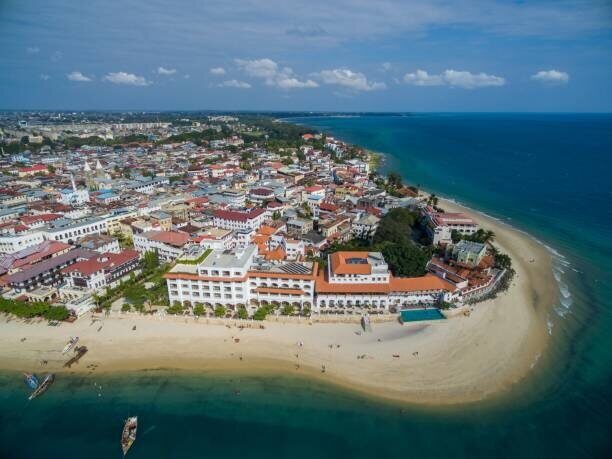
Nothing here is far from anything else. The difficulty is that the lanes bend, branch and double back, so a route that looks like ten minutes on a map takes twenty five and passes three things you did not plan to see.
Getting Your Bearings on a Stone Town Walking Tour
Orientation is simpler than it feels once you fix three points in your head.
The sea is always west. Mizingani Road runs along that seafront past the Old Fort, the House of Wonders and the Palace Museum. Creek Road marks the eastern edge of the quarter, where Darajani Market sits and where the old town gives way to the newer city beyond. Everything you want is in the roughly triangular area between them.
Inside that triangle, navigation by street name is hopeless. Locals navigate by landmark, and so should you: the cathedral spire, the fort walls, the market entrance, a particular carved door. Phone maps work poorly here because the lanes are too narrow to register properly.
Getting lost is genuinely part of it and rarely lasts long. Walk in any direction for five minutes and you hit either the sea or Creek Road.
Take a guided walk on your first morning and then explore alone afterwards. Two hours with someone who knows the quarter makes the rest of your time here far more productive than a full day of wandering blind.

The Lanes, the Doors and How the Quarter Was Built
The quarter went up largely across the nineteenth and twentieth centuries, built from coral rag quarried on the island and bound with lime mortar made by burning coral. It is a porous material, which is why the facades weather so visibly and why restoration here is slow, expensive and never finished.
Buildings run three and four storeys with the lanes between them barely wide enough for two people to pass, which is deliberate. Narrow shaded streets stay cool, and there were no carts to accommodate.
The doors are what everyone comes to see. Two traditions dominate: Indian influenced frames, rounded at the top with brass studs standing proud of the panels, and Omani frames, square and heavy, carved with chains, lotus motifs, fish and Arabic script. A door announced the household’s trade, faith and standing to anyone passing.
Look up, not just at doorframes. Carved balconies, shuttered windows and the occasional stretch of stucco survive on upper floors where the street level has been rebuilt.

The Mkunazini Slave Trade Sites
The most important stop in the quarter sits about ten minutes inland from the seafront, and it should be done in the morning while you have the energy for it.
Mkunazini held East Africa’s largest slave market, through which an estimated fifty thousand people passed annually at the trade’s height in the 1860s. After Sultan Barghash signed the abolition treaty in 1873, Bishop Edward Steere had Christ Church Cathedral built directly over the site, with the altar deliberately placed where the whipping post had stood.
Beneath the neighbouring building are two holding chambers where captives were confined before sale. They are low enough that an adult cannot stand, unventilated, and very small. Guides explain the numbers held in them, and it is the twenty minutes of this quarter that people remember longest.
Clara Sörnäs’s memorial stands in the grounds, five figures in a pit with their necks chained together, unveiled in 1998. Cover shoulders and knees; a khanga is lent at the gate if needed.
The Mizingani Seafront and the Sultans’ Buildings
The waterfront run takes an hour at an easy pace and covers the whole sultanate period.
The Old Fort, Ngome Kongwe, is the oldest standing building here, raised by the Busaidi Omanis between 1698 and 1701 over a Portuguese church whose fragments remain in the courtyard walls. Entry is free, the courtyard holds craft shops and an amphitheatre, and the front office opens daily from eight until six.
Next along, the House of Wonders was built in 1883 for Sultan Barghash as a ceremonial hall and was the first building in Zanzibar with electricity and the first in East Africa with a lift. Part of it collapsed in December 2020 and it is closed, viewable from the street only.
Further north sit the Palace Museum, the sultans’ actual residence, and the Old Dispensary, built between 1887 and 1894 as a charity hospital and among the most finely decorated buildings in the quarter, with carved balconies and stained glass.
Two hours on this seafront covers a Portuguese church, an Omani garrison, a sultan’s ceremonial hall, a colonial dispensary and a national museum. All of it within four hundred metres.

Shopping, Workshops and Markets in the Quarter
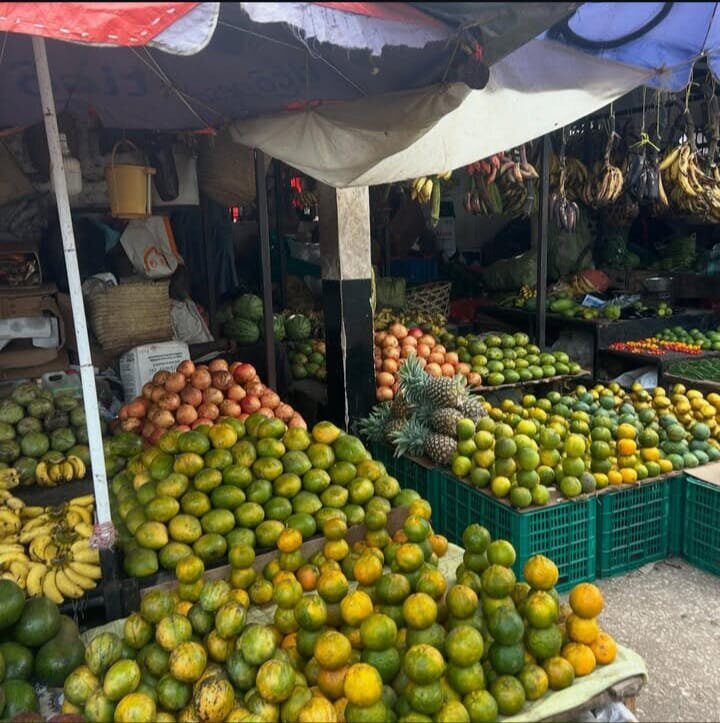
Darajani Market on Creek Road is where the city actually shops. Produce stacked in pyramids, spices sold loose by weight from open sacks, fabric, household goods and a fish hall that is not for everyone. Go before nine, when the produce is best and the covered sections have not yet become an oven.
Inside the Old Fort courtyard, craft shops and working workshops sell carvings, paintings, fabric and jewellery at a gentler pace than the market, with an art gallery in the corner towers.
Through the lanes you will find antique dealers, tailors working to order, and shops selling khanga and kitenge by the length. Khanga carries a Swahili proverb along one edge chosen deliberately by the buyer, so ask for a translation before choosing. Prices are negotiable everywhere and the first quote to a visitor is not the local one.
Coffee, Rooftops and Places to Stop
Exploring here is hot work, and the quarter is well supplied with reasons to pause.
Zanzibar coffee is sold from long spouted pots by vendors working the small squares, poured into tiny cups and drunk standing up. It costs almost nothing and it is one of the more sociable things you can do here.
Several restored merchant houses open their rooftop terraces to non residents in the late afternoon. From three or four storeys up, the roofline of coral stone, satellite dishes and minarets against the channel finally makes sense, and the call to prayer carrying across it at dusk is the sound most visitors associate with the town afterwards.
Local restaurants through the quarter serve pilau, biryani, fish curry and coconut beans at everyday prices, and they are consistently better than the tourist facing places on the seafront.

Stone Town After Dark
Forodhani Gardens is where the evening happens. From around six the seafront park fills with charcoal grills, seafood skewers, urojo soup, sugarcane juice pressed by hand and Zanzibar pizza. Local families take the sea wall, boys leap from it at high tide, and it runs until about nine.
The Old Fort amphitheatre stages taarab and ngoma performances through the year, advertised on boards at the gate rather than online. Taarab can also be heard at the Dhow Countries Music Academy near the Palace Museum.
One practical warning. The lanes are poorly lit and easy to get turned around in after dark, and this is where most incidents involving visitors occur. Take a taxi back to your accommodation rather than walking through unfamiliar alleys, even a short distance.
A One Day Stone Town Itinerary
7.00 to 9.00. Walk the lanes while the quarter belongs to people going about their day. Best light for the doors and the coolest hours for being on your feet.
9.00 to 10.30. Mkunazini for the cathedral, the holding chambers and the memorial. Take a guide. Allow an hour and expect it to sit with you.
10.30 to 11.30. Darajani Market, a few minutes east, before the heat builds in the covered halls.
Midday to 3.00. Lunch at a local restaurant and stop moving. The middle of the day here defeats most people, and everything worth seeing is still there at four.
3.30 to 5.30. The Mizingani seafront: Old Fort, House of Wonders exterior, Palace Museum and the Old Dispensary, in the best light of the day.
5.30 onwards. A rooftop terrace for sunset, then down to Forodhani as the grills are lit.
Getting to Stone Town and Practical Notes
Stone Town occupies the western promontory of Unguja, fifteen to twenty minutes by road from Abeid Amani Karume International Airport. Ferries from Dar es Salaam dock at the port on the northern edge of the quarter after a crossing of one and a half to two hours, which puts you within walking distance of most old town accommodation.
Cars cannot enter most of the quarter, so expect to walk the last stretch with luggage. Wear closed shoes with grip: the coral stone is uneven and gets slick after rain.
Cover shoulders and knees away from the seafront. Carry small Tanzanian shilling notes, since cards work only at larger hotels and restaurants, and bring US dollars printed in 2000 or later if you are exchanging.
Frequently Asked Questions About Exploring Stone Town
Can you explore Stone Town without a guide?
Yes, and most people do after a first guided walk. The quarter is compact and safe in daylight, and getting lost rarely lasts long since you hit either the sea or Creek Road within a few minutes. What a guide adds is context you cannot get from a plaque, and licensed guided walks cost roughly $20 to $40 per person for two to three hours.
How much does a day in Stone Town cost?
Very little. The Old Fort and Darajani Market are free, the Old Slave Market and Anglican Cathedral costs around $5, and a guided walking tour runs $20 to $40. Lunch at a local restaurant is $3 to $6, and dinner at the Forodhani night market $6 to $12. A sunset dhow cruise adds $25 to $40. A full day rarely exceeds $60 per person including a guide.
Is one day enough for Stone Town?
One full day covers the main sites at a reasonable pace. Two nights is better, since it gives you a complete day plus an evening at Forodhani and an early morning at Darajani without rushing either. Most visitors stay one or two nights on arrival before moving to a beach.
What should you avoid in Stone Town?
Walking unfamiliar lanes alone after dark, since lighting is poor and this is where most incidents occur. Agreeing taxi fares after the ride rather than before. Unofficial guides who attach themselves near the port, the fort and the market and expect payment afterwards. Beachwear away from the seafront, which reads as disrespectful in a predominantly Muslim quarter.
Are cars allowed in Stone Town?
Not through most of it. The lanes were built before vehicles and are too narrow for them, so the quarter is explored entirely on foot. Taxis drop you at the nearest accessible corner and you walk the last stretch, which is worth knowing if you are arriving with heavy luggage.
What is the best time of day to explore Stone Town?
Early morning between seven and nine for the lanes, when the light is soft and the quarter is at its most ordinary and interesting. Late afternoon from about half past three for the seafront, when the light lands on the buildings. The middle of the day is hot enough that most visitors stop taking anything in.
Stone Town is easy to walk and hard to read, and the difference between an interesting day and a pleasant but blurry one is usually whoever is walking beside you. Holidays To Zanzibar works with licensed Zanzibari guides raised in these lanes, who know which buildings are open in any given week and handle the difficult history properly.
For a day in the old quarter built around what interests you, get in touch with Holidays To Zanzibar and a real person will reply.