Stone Town is the old coral stone quarter of Zanzibar City, inscribed on the UNESCO World Heritage List in 2000 and best explored on a guided walking tour of two to three hours. Visitors can join tours on arrival or arrange them through any hotel in the quarter. Built largely during the 19th and 20th centuries under Omani rule, Stone Town was the Sultanate’s trading capital and remains East Africa’s most complete surviving Swahili coastal town.
Most people arriving in Zanzibar want the beach, and they treat the old town as an inconvenience between the airport and the coast road. That is a shame, and it is also fixable with a single well spent day.
Stone Town Walking Tours Through the Old Quarter
A Stone Town walking tour is the only sensible way to meet the place. The lanes are too narrow for cars in most of the quarter, they bend without warning, and the same alley can look entirely different depending on which end you entered from. Getting lost is part of it. Getting lost with someone who knows which doorway leads where is considerably more productive.
Guided tours typically run two to three hours and cover the seafront landmarks, the market, the cathedral and a loop through the residential lanes. Guides are licensed, and the good ones will tailor the route to what interests you rather than marching through a fixed list. If your interest is architecture, say so; if it is the trading history, say that instead.
The town works on your feet and nothing else. Wear something you can walk in for hours over uneven coral stone. Cover your shoulders and knees away from the seafront, since the population is predominantly Muslim and modest dress is expected in the residential areas.
Start early. By ten in the morning the lanes are hot and the light is flat. Between seven and nine the quarter belongs mostly to people going about their day, which is when it is at its most interesting to walk through.
The Carved Doors of Stone Town on a Self Guided Architecture Tour
If you do one thing without a guide, make it a slow Stone Town tour of the doors. There are hundreds of them, and they are the clearest surviving record of who lived here and where their money came from.
Two broad styles dominate. The Indian influenced doors are rounded at the top, often with brass studs projecting from the panels. The Omani and Arab style doors are square framed with heavy lintels, carved with chains, lotus motifs, fish and passages of Arabic script. The carving on a door signalled the household’s trade, faith and standing. A merchant house with an especially elaborate frame was making a statement to everyone who walked past it.
The buildings behind them share a common construction. Coral rag quarried locally, bound with lime mortar, rendered and lime washed. It is a porous material that breathes with the humidity, which is why so many facades look weathered even when the structure behind is sound. It is also why restoration here is so slow and expensive, and why some buildings in the quarter are visibly losing the fight.
Old Fort and House of Wonders on the Stone Town Seafront Tour
The seafront section of any Stone Town tour takes in the two buildings that dominate the skyline. The Old Fort, known locally as Ngome Kongwe, was raised by the Busaidi Omanis between 1698 and 1701 on the footprint of a Portuguese church built a century earlier. Fragments of that church are still visible in the courtyard walls. It served as a garrison, later a prison where executions took place, and later still, under the British, as a rather genteel ladies’ tennis court screened from public view.
Today the courtyard holds craft shops, workshops, a small amphitheatre and a restaurant. Entry is free. The Sauti za Busara music festival in February and the Zanzibar International Film Festival in July both use it as a venue, and if your visit coincides with either, the fort is the centre of everything.
Next door stands the House of Wonders, or Beit al Ajaib, built for Sultan Barghash bin Said in 1883. It was the first building in Zanzibar with electricity and the first in East Africa with a lift, which is where the name came from. A section of it collapsed on Christmas Day in 2020 during restoration work, killing two workers, and the building has been closed since. A restoration programme funded by Oman and coordinated with UNESCO is under way. For now it is viewed from the outside only, behind hoarding, which is worth knowing before you build a day around it.
Slave Market and Christ Church Cathedral Heritage Tours
The heritage tour that most visitors remember longest is the one at Mkunazini. This was the site of East Africa’s largest slave market, through which an estimated fifty thousand people passed annually at the trade’s height in the 1860s. Sultan Barghash signed the abolition treaty in 1873 under British pressure, and the market closed.
Bishop Edward Steere had the Anglican cathedral of Christ Church built directly on top of it between 1873 and 1880. The altar sits deliberately on the spot where the main whipping post stood. Steere designed the barrel vaulted roof himself, against local expectation that it would not hold, and he died before the building was finished; he is buried behind the altar. In the grounds, Clara Sörnäs’s 1998 memorial shows five figures in a pit, necks chained together.
Beneath the neighbouring building are two holding chambers where captives were kept before sale. They are low, airless and very small. Guides explain the numbers held in them. It is a difficult twenty minutes and it is the single most important thing in the quarter.
Nothing in Stone Town explains the town’s wealth as directly as the chambers under Mkunazini. The doors and the balconies were paid for here.
Darajani Market and Spice Trading Tours in Stone Town
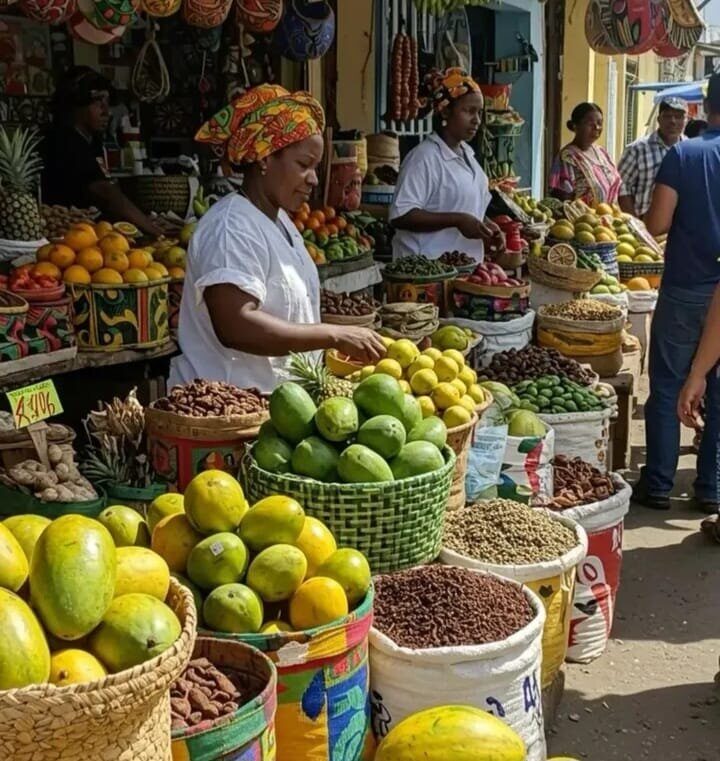
On the eastern edge of the old quarter, Darajani Market is where Zanzibar City actually shops, and any decent Stone Town tour passes through it. Produce, spices, fabric, household goods and a fish section that is not for the squeamish, all packed into corridors that were never designed for the volume they now carry.
The spice stalls are the reason the archipelago earned its old nickname. Cloves, cardamom, nutmeg, cinnamon bark, vanilla, black pepper and turmeric are sold loose by weight. Prices are negotiable and the first quote to a visitor is not the local one. That is normal, not personal.
Go in the morning. Afternoon heat in the covered sections is genuinely unpleasant, and the best of the produce has gone by then.
Forodhani Gardens Evening Food Tours on the Waterfront
At dusk the waterfront park in front of the Old Fort turns into a food market, and a Forodhani Gardens tour is how most visitors eat their first Zanzibari meal. Charcoal grills go up, tables fill with skewered fish, octopus, prawns and squid, and vendors call over anyone who slows down.
The house speciality is Zanzibar pizza, which is not pizza in any recognisable sense. It is a thin dough pocket filled with minced meat, egg, onion, cheese and whatever else the cook favours, folded and fried flat on a griddle. Sweet versions with banana and chocolate follow at the end. Urojo, sometimes called Zanzibar mix, is a tangy turmeric soup loaded with fritters, potato and chutney.
Choose stalls with visible turnover and food cooked in front of you rather than sitting under a lamp. Agree the price before it is handed over. The seawall along the front fills with local families in the early evening and it is one of the more pleasant hours anywhere in the town.
Stone Town Sunset Dhow Cruises and Rooftop Terraces
Sunset here faces west across the channel, which means the whole waterfront gets it. Dhow cruises leave from the beach in front of the Old Fort in the late afternoon and run a slow loop offshore under sail, usually for an hour or two, often with drinks included. Boats vary enormously in condition and it is fair to look before you commit.
The alternative is a rooftop. Several restored merchant houses in the quarter have opened their upper terraces to non residents, and from three or four storeys up the roofline of coral stone, satellite dishes and minarets makes more sense than it does at street level. The call to prayer carrying across the roofs at dusk is the sound most people associate with the town afterwards.
Getting to Stone Town and Where It Sits
Stone Town occupies the western promontory of Unguja, the main island of the Zanzibar Archipelago, roughly a quarter of an hour from Abeid Amani Karume International Airport. It is the historic core of the larger Zanzibar City rather than a separate settlement.
Fast ferries from Dar es Salaam dock at the port on the northern edge of the quarter, taking around one and a half to two hours across the Zanzibar Channel, with several sailings daily. Flights from Dar es Salaam, Arusha, Nairobi and Kilimanjaro land throughout the day, plus seasonal direct services from Europe and the Gulf.
From the old town, the north coast beaches at Nungwi and Kendwa are roughly an hour and a half by road, the east coast around an hour, and Jozani Chwaka Bay National Park thirty to forty five minutes.
Best Time to Visit Stone Town
June to October. The long dry season. Comfortable walking temperatures by island standards, low humidity, minimal rain. Busiest and most expensive, and the film festival falls in July.
January and February. Hot, dry and bright. February brings Sauti za Busara, which fills the Old Fort and pushes accommodation rates in the quarter sharply upward.
March to May. The long rains, heaviest in April. Walking the lanes in a downpour is not fun, though the town is quiet and rates are at their lowest.
November to December. Short rains, usually brief afternoon showers. Fine for sightseeing until the Christmas surge arrives.
Frequently Asked Questions About Visiting Stone Town
How much does a Stone Town tour cost?
Guided walking tours run from about $20 to $40 per person for a group departure of two to three hours, with private guides costing more. Entry to the Old Slave Market and Anglican Cathedral site is around $5, which includes access to the holding chambers. The Old Fort is free. Sunset dhow cruises from the waterfront typically start around $25 to $40 per person depending on the boat and whether drinks are included.
Is the House of Wonders open to visitors?
No. Part of the building collapsed in December 2020 during restoration and it has been closed since. A restoration programme funded by Oman and coordinated with UNESCO is ongoing, with no confirmed reopening date. You can see the exterior from Mizingani Road and from the Old Fort courtyard, but the museum inside is not accessible.
How long should you spend in Stone Town?
One full day covers the main sites at a comfortable pace. Two nights is better, because it gives you a full day of sightseeing plus an evening at Forodhani and a morning at Darajani without rushing. Many visitors treat it as a bookend, staying one or two nights on arrival before moving to the coast.
What should you wear in Stone Town?
Shoulders and knees covered for both men and women once you leave the seafront. Women are lent a khanga wrap at the cathedral entrance if needed. Beachwear is fine on the waterfront but not in the residential lanes or the market. Closed shoes with grip are worth it on the coral stone, which gets slick after rain.
Is Stone Town safe for tourists?
Broadly yes, with normal precautions. Petty theft and bag snatching are the main risks, and violent crime against visitors is rare. The lanes are poorly lit after dark and easy to get turned around in, so take a taxi at night rather than walking back through unfamiliar alleys. Agree taxi fares before getting in. Unofficial guides approaching visitors near the port and the fort are common; book through your hotel instead.
Why is Stone Town a UNESCO World Heritage Site?
It was inscribed in 2000 as the most complete surviving example of a Swahili coastal trading town, showing the fusion of African, Arab, Indian and European influences in its architecture and urban fabric over more than a thousand years of Indian Ocean trade. Its role in the East African slave trade and the subsequent abolition movement formed part of the case for listing.
Stone Town rewards a guide more than almost anywhere else in East Africa, because so much of what matters here is invisible without one. Holidays To Zanzibar works with licensed local guides who grew up in these lanes and can tell you which door belongs to which family and why the cathedral sits where it does. They will also be straight with you about what is closed, which matters more here than most places.
If you want a day in the old town built around what actually interests you, rather than a fixed circuit, get in touch with Holidays To Zanzibar and a real person will help you shape it.