The former slave market at Mkunazini in Stone Town is now the site of Christ Church Anglican Cathedral, open daily to visitors with a single ticket covering the church, the underground holding chambers, the memorial and the exhibition. Guided tours of the site run throughout the day. Zanzibar held East Africa’s largest slave market here until abolition in 1873, and the cathedral was deliberately built over it.
This is the hardest hour you will spend in Zanzibar and the one that makes the rest of the island legible. The doors, the palaces, the clove plantations and the merchant houses were all paid for by what happened on this plot.
What a Former Slave Market Tour Covers
The site sits on Mkunazini Road, about ten minutes inland on foot from the seafront. A slave market tour here takes forty five minutes to an hour and covers four things: the cathedral itself, the underground chambers where captives were held before sale, the memorial sculpture in the grounds, and a small exhibition on the East African slave trade.
You pass through a security gate before entering the compound, where bags are checked. The ticket office is just inside, and it is also where you arrange a guide if you do not already have one. Guides are optional. They are also the difference between looking at a low brick room and knowing what it was, so most visitors take one.
Modest dress is required. Women arriving in shorts or short skirts are lent a khanga, the printed cotton wrap worn across the Swahili coast, to cover their knees. This is handled at the gate without fuss.
Go in the morning if you can, and do not schedule anything cheerful immediately afterwards. Most people want a quiet hour and a cup of tea before moving on to the market or the seafront.
Zanzibar’s Slave Trade and the Mkunazini Market
Zanzibar sat at the centre of the Indian Ocean slave trade for most of the 19th century. Captives were taken from the interior of what is now Tanzania, Malawi, Zambia and the eastern Congo, marched to the coast, shipped across the channel and sold here before being moved on to the plantations of the islands, to Arabia, to Persia and beyond.
At the trade’s height in the 1860s, an estimated fifty thousand people passed through this market annually. The clove economy that made Zanzibar wealthy ran on enslaved labour on the island’s own plantations, so a substantial share never left.
British pressure mounted through the middle of the century, driven partly by the missionary movement and partly by naval enforcement in the western Indian Ocean. In 1873 Sultan Barghash bin Said signed the treaty that ended the trade and closed the Mkunazini market. The trade did not stop instantly; clandestine holding sites operated north of the town for years afterwards. But the market itself shut, and the plot became available.
The Underground Holding Chambers on the Site Tour
Beneath the buildings beside the cathedral are two chambers where captives were held before sale. They are the part of the Stone Town heritage tour that people remember.
The rooms are low. An adult cannot stand upright in them. Ventilation comes from a couple of small openings at ground level on the far side, and a shallow trench runs across the floor. Guides explain how many people were confined in each chamber at one time, and how long they were kept there before being brought up to the market. The numbers are hard to hold in your head while standing in the room.
Both chambers are accessible by a narrow stair. Anyone with mobility difficulties or a serious problem with confined spaces should know that in advance. The exhibition upstairs covers the same ground with photographs and documents for those who would rather not go down.
The cathedral above is the argument. The chambers below are the evidence. You need both to understand why the building sits where it does.
Christ Church Cathedral Built Over the Market
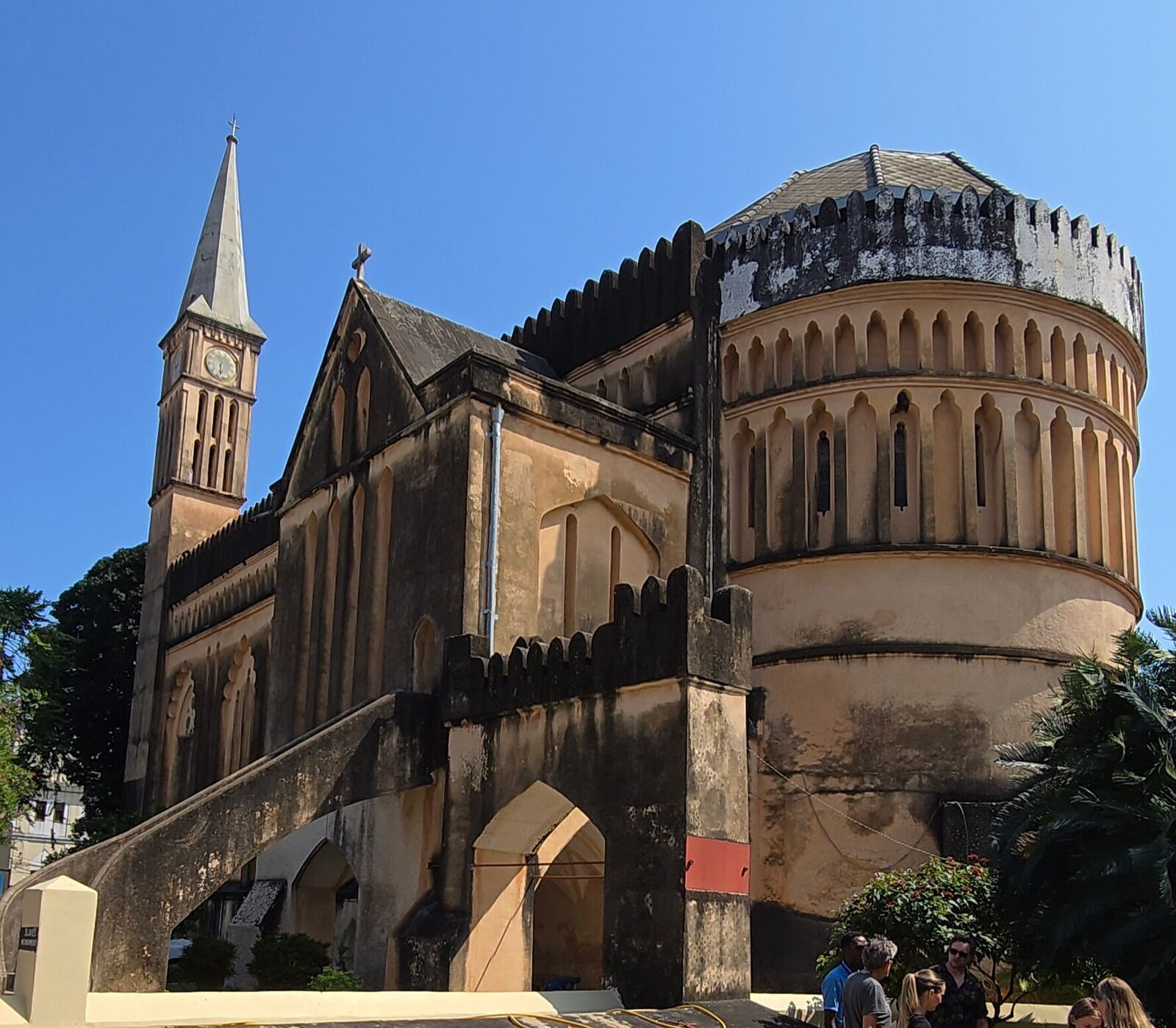
Construction began on Christmas Day 1873, the year of abolition, and the main structure was completed by the end of the decade. The cathedral was consecrated in 1903. It was the first Anglican cathedral in East Africa and it remains an active parish church rather than a museum piece, with services held regularly.
The placement was deliberate in every detail. The altar stands on the exact spot where the market’s main whipping post stood. That was the whole point of building here rather than on any of the easier sites available in the town.
Architecturally it is a hybrid, which is what makes it interesting on a Stone Town walking tour. The bones are Gothic, with a tall spire on the south west corner, but the detailing borrows from Islamic and Swahili traditions found across the quarter. The material is locally quarried coral stone, the same porous rag used in every other building in Stone Town, which is why the walls have aged the way they have.
Inside, look for the wooden cross near the altar. It is said to have been made from the tree that marked the spot where David Livingstone’s heart was buried in what is now Zambia. Livingstone’s campaigning against the East African trade fed directly into the pressure that closed this market.
Bishop Edward Steere and the Barrel Vault Roof
The cathedral exists because of Edward Steere, the third Bishop of Zanzibar, an abolitionist who had worked alongside Livingstone. He directed the construction and he designed the roof himself.
The barrel vault was his own invention and local builders did not believe it would stand. Spanning a nave of that width in coral stone with the techniques available on the island in the 1870s was, on the face of it, unwise. It has held for close to a century and a half.
Steere died in 1882, before the building was fully finished. He is buried behind the main altar, which places his grave on the same spot as the whipping post. That was not an accident either.
The Slave Memorial in the Cathedral Grounds
In the compound outside stands the memorial by the Swedish Tanzanian sculptor Clara Sörnäs, unveiled in 1998. Five figures, men and women, stand in a pit below ground level with their necks chained together by a length of iron.
The chain is real, recovered from the period. The faces are finely worked while the bodies below are left rough, which draws your eye upward to the expressions. Standing at the rail looking down into the pit puts you in the position of someone at the market, which is the point of the composition.
It is the most photographed object on the site. It is also worth standing at for a few minutes before reaching for a camera.
The Heritage Exhibition on the Site Tour
A small museum on the compound covers the East African slave trade in more detail than a guide can deliver on foot: the trade routes inland, the numbers, the caravan system, the naval suppression campaign, the abolition treaty, and the long afterlife of the trade in the region.
It also covers the missionary societies that campaigned against it, without glossing over the fact that the same movement carried colonial ambitions of its own. Beside the entrance stands St Monica’s Lodge, a handsome double storey building dating to around the 1880s, closed for restoration for some years now.
Allow twenty minutes for the exhibition if you want to read properly rather than skim.
Combining the Cathedral With a Stone Town Walking Tour
Mkunazini sits inland from the seafront, roughly ten minutes on foot from the Old Fort through the lanes. Most guided Stone Town tours pair the cathedral with the seafront landmarks in one circuit: the Old Fort, the House of Wonders exterior, the Palace Museum, then inland to the cathedral, then back out to Forodhani Gardens for the evening food market.
Darajani Market is a few minutes further east, which makes a natural continuation. Some visitors prefer to break the two up, doing the cathedral in the morning and the market and seafront later, simply because the two experiences sit oddly next to each other.
Getting There, Opening Hours and What to Wear
The site is on Mkunazini Road in the eastern part of Stone Town, Zanzibar City, on Unguja island. From the airport it is around twenty minutes by road, and from the ferry terminal a fifteen minute walk through the quarter. Taxis will drop you at the corner; the lanes are too narrow to reach the gate itself.
The compound is open daily during standard daytime hours, with the last entry in the late afternoon. Services take place on Sundays and visiting is restricted during them, so plan around it. Shoulders and knees covered for everyone, and closed shoes are sensible for the stair down to the chambers.
Frequently Asked Questions About the Former Slave Market and Cathedral
Zanzibar’s Other Slave Trade Sites
The Mkunazini site tells the story of the market, but it is not the only place connected to the trade. North of Zanzibar City, the Mangapwani slave chamber was cut into the coral rock around 1880, seven years after abolition, by the trader Mohammed bin Nassor Al Alwi, and used to hold captives landed from Bagamoyo on a concealed beach. A coral cave with a freshwater pool sits nearby.
See the Mkunazini memorial and cathedral first, since it frames the history, and Mangapwani then works as a half-day trip, usually around twenty to thirty dollars including the coral cave.
How much is entry to the slave market and Anglican Cathedral?
Around $5 per person, which covers the cathedral, the underground holding chambers, the memorial and the exhibition. A site guide is optional and usually costs a further $5 to $10, or you can tip a guide directly. Guided Stone Town walking tours that include this site run $20 to $40 per person for a group departure, with the entry fee sometimes included and sometimes not, so ask when booking.
How long does the visit take?
Forty five minutes to an hour with a guide, covering the church, the chambers, the memorial and the exhibition. Allow longer if you want to read the displays properly. Most people find an hour is enough, and the intensity of the chambers means few visitors want to linger beyond that.
Can you go inside the slave chambers?
Yes. Both holding chambers are open to visitors and accessed by a narrow stair. They are low enough that an adult cannot stand upright. If you have mobility problems or find confined spaces genuinely difficult, the exhibition above covers the same history without the descent.
Is the cathedral still an active church?
Yes. Christ Church is a working Anglican cathedral with regular services, and it was the first Anglican cathedral built in East Africa. Visiting is restricted during services, particularly on Sundays, so check timings if your schedule is tight.
Is this site suitable for children?
Older children and teenagers usually manage it well and get a great deal from it, particularly with a guide who pitches the explanation appropriately. For younger children the chambers can be genuinely upsetting, and the subject matter is not softened anywhere on the site. Parents know their own children best; the exhibition alone is a reasonable middle ground.
What should you wear to visit?
Shoulders and knees covered for both men and women. Women arriving in shorts or short skirts are lent a khanga wrap at the entrance. Closed shoes are advisable for the stairs to the chambers, and the coral stone underfoot is uneven throughout the compound.
This site is the reason many visitors leave Zanzibar knowing the island rather than just having enjoyed it, and a guide who handles the subject with care makes a real difference. Holidays To Zanzibar works with Zanzibari guides who tell this history straight, without either sensationalising it or hurrying you through the difficult parts.
If you want a Stone Town day that gives this place the time it needs, contact Holidays To Zanzibar and someone on the island will help you plan it.